



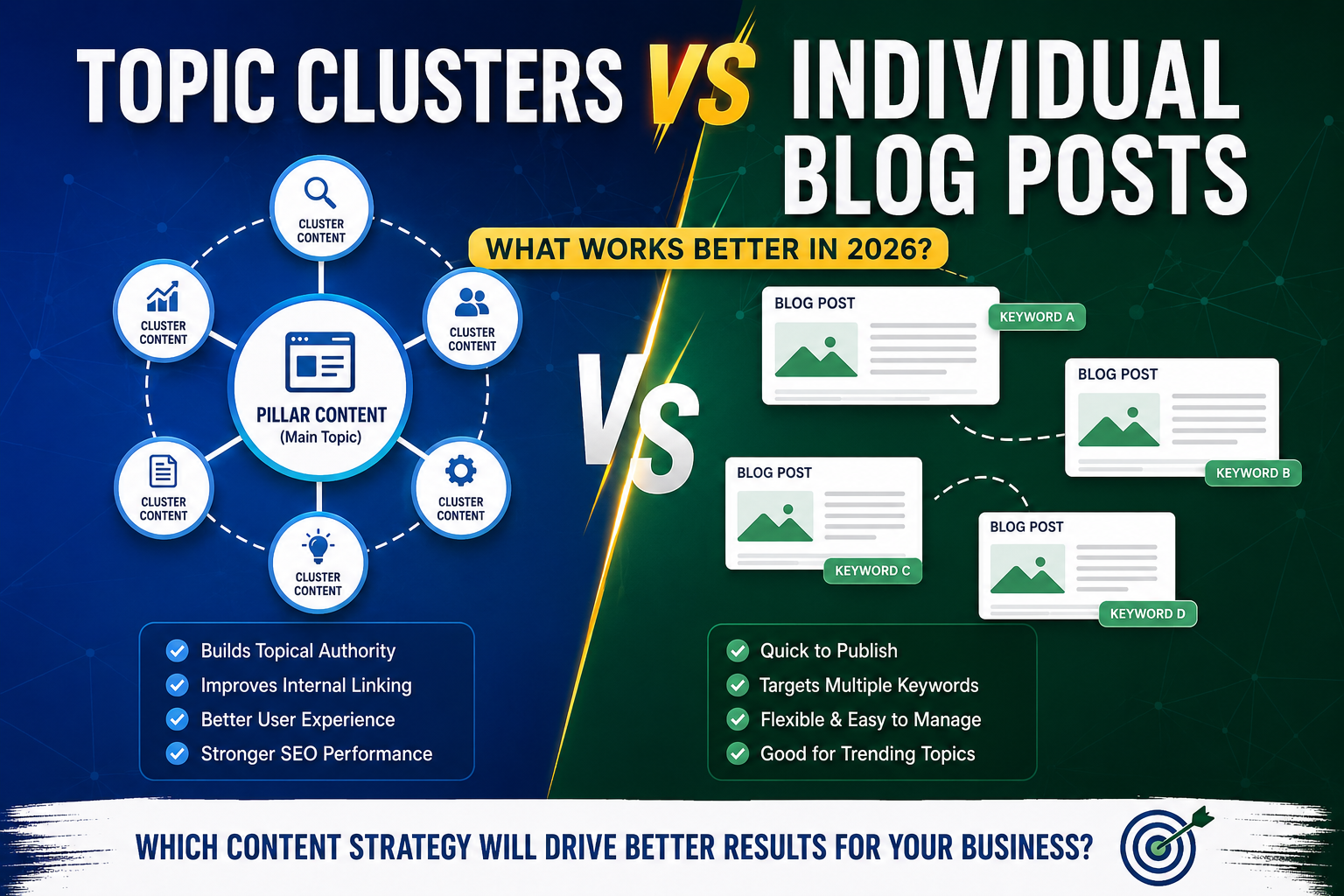
Topic Clusters vs Individual Blog Posts: What Works Better in 2026?
Content marketing and SEO have changed dramatically over the last few years. In 2026, simply publishing random blog posts is no longer enough to achieve strong Google rankings. Search engines have become smarter, user intent has become more important, and websites now need structured content strategies to build authority online.
This has created an ongoing debate among marketers and SEO professionals — should businesses focus on topic clusters or continue publishing individual blog posts?
Both approaches can generate traffic and improve visibility, but the way Google evaluates content today has shifted significantly. Search engines now prioritize websites that demonstrate expertise, topical authority, and well-organized information structures.
Understanding the difference between Topic Clusters vs Individual Blog Posts is essential for businesses that want long-term SEO growth in 2026. Choosing the right content strategy can impact rankings, organic traffic, user engagement, and overall website authority.
Understanding Topic Clusters
A topic cluster is a structured content model where multiple related articles connect back to a central pillar page. Instead of publishing isolated blogs, websites create groups of interconnected content around a broader subject.
For example, a digital marketing website may create a pillar page about “Local SEO,” then publish supporting blogs related to:
- Google Business Profile optimization
- Local keyword research
- Google Maps ranking
- Local backlink strategies
- Mobile SEO for local businesses
Each supporting article internally links back to the main pillar page while also connecting with other related articles within the cluster.
This content cluster strategy helps search engines understand the relationship between topics and improves topical authority for the entire website.
In 2026, Google increasingly rewards websites that provide deep, structured coverage of specific subjects rather than isolated pieces of content.
What Are Individual Blog Posts?
Individual blog posts are standalone articles that target separate keywords without being heavily connected to a broader topic structure. Unlike a structured Topic clusters SEO strategy, these articles are usually published independently without strong internal linking or a centralized pillar page approach.
This traditional blogging method has been used for years because it is simple, flexible, and easy to manage. Businesses often publish blogs based on trending topics, customer questions, or keyword opportunities without organizing them into a larger content ecosystem. While this approach can still generate traffic, many businesses are now shifting toward a more organized Topic clusters SEO strategy to improve topical authority, user experience, and long-term search rankings.
For example, a business may publish unrelated blogs like:
- Best SEO tools
- Instagram marketing tips
- Website design trends
- PPC advertising guide
While these blogs can still rank individually, they may not contribute strongly toward building topical authority unless properly connected through internal linking and strategic content planning.
The challenge with Individual blog posts SEO in 2026 is that standalone content often struggles to compete against websites using advanced topic cluster structures.
Why Google Prefers Topic Clusters in 2026
Search engines now focus heavily on semantic understanding and search intent. Google wants to rank websites that fully cover topics instead of partially answering user queries.
A strong Topic clusters SEO strategy helps search engines identify:
- Content depth
- Subject expertise
- Internal content relationships
- Website relevance
- User experience quality
When multiple articles support a central topic, Google sees the website as more authoritative and trustworthy.
This structured approach also improves crawlability. Search engine bots can navigate related pages more effectively through internal linking, helping pages get indexed faster and distribute ranking authority more efficiently across the website.
Topic clusters also improve user engagement because visitors naturally move between related articles, increasing session duration and reducing bounce rates.
The SEO Benefits of Topic Clusters
One of the biggest advantages of topic clusters is topical authority. In 2026, authority is becoming one of the strongest ranking factors in competitive niches.
Instead of trying to rank a single blog post, websites using clusters build authority across an entire subject area. This increases the chances of ranking for:
- Primary keywords
- Long-tail keywords
- Semantic search queries
- Voice search results
- AI-generated search summaries
Another major benefit is stronger internal linking. Proper internal links help distribute page authority across the website while guiding users toward related content.
Topic clusters also create a better user experience. Visitors can easily find additional relevant information instead of leaving the website after reading one article.
Businesses investing in structured content cluster strategy models often experience:
- Higher organic traffic
- Better keyword rankings
- Improved engagement
- Increased authority
- Stronger lead generation
Are Individual Blog Posts Still Effective?
Although topic clusters are becoming increasingly important, individual blog posts are not completely outdated.
Standalone blogs still work well for:
- Trending topics
- News updates
- Seasonal content
- Quick informational searches
- Viral content marketing
Individual posts can generate fast traffic and help businesses target specific keyword opportunities quickly.
However, relying only on disconnected blog posts creates long-term SEO limitations. Without a structured content architecture, websites often struggle to build consistent authority in competitive search results.
In 2026, individual blog posts perform best when they are integrated into broader topic ecosystems rather than existing independently.
The Role of Internal Linking
Internal linking has become one of the most critical SEO elements in modern content marketing.
Topic clusters naturally encourage strategic internal linking between related pages. This creates a clear content hierarchy that helps both users and search engines navigate the website more effectively.
A well-optimized internal linking structure:
- Improves page authority distribution
- Helps Google understand content relationships
- Enhances crawl efficiency
- Increases user engagement
- Supports ranking improvements
Many websites fail to maximize SEO potential simply because their blog posts are isolated without meaningful connections.
This is one reason why Topic clusters SEO strategy models are outperforming traditional blogging methods in many industries.
Which Strategy Works Better in 2026?
In 2026, topic clusters clearly provide stronger long-term SEO advantages compared to publishing random standalone articles.
Search engines are prioritizing:
- Topical authority
- Semantic relevance
- User-focused content
- Structured information architecture
Websites using topic clusters are better positioned to compete in increasingly crowded search environments.
However, this does not mean businesses should stop creating individual blog posts entirely. The most effective approach is combining both strategies intelligently.
A modern SEO strategy should use:
- Pillar pages for broad topics
- Supporting cluster content for authority
- Individual blogs for trends and fresh traffic opportunities
This hybrid model allows businesses to build long-term authority while maintaining content flexibility.
The Future of SEO Content Strategy
As AI-powered search continues evolving, content organization will become even more important. Search engines are moving toward understanding complete topics instead of relying solely on keyword matching.
Businesses that create well-structured content ecosystems will have a major competitive advantage in future search rankings.
The future of SEO content will focus on:
- Semantic search optimization
- Topical authority
- User intent satisfaction
- AI-friendly content structures
- Contextual relevance
This makes structured content cluster strategy planning more important than ever for sustainable organic growth.
Final Thoughts
The debate around Topic Clusters vs Individual Blog Posts is becoming increasingly relevant as SEO evolves in 2026. While standalone blogs can still generate traffic and visibility, topic clusters offer stronger long-term advantages for building authority, improving rankings, and increasing organic growth.
Businesses that rely only on isolated content may struggle to compete against websites using advanced topical SEO structures. On the other hand, brands that build organized content ecosystems are better positioned to dominate search results and establish industry authority.
A smart SEO strategy today combines the power of topic clusters with strategically targeted individual posts. This balanced approach helps businesses maximize visibility, improve user experience, and achieve sustainable long-term SEO success in the rapidly changing digital landscape.
Frequently Asked Questions (FAQ)
1. What is a topic cluster in SEO?
A topic cluster is a content strategy where multiple related articles are connected to a main pillar page through internal linking. This structure helps search engines understand topic relevance and improves website authority for broader subjects.
2. What are individual blog posts?
Individual blog posts are standalone articles that target specific keywords or topics without being strongly connected to a larger content structure. They are commonly used for news, trends, and informational content.
3. Which is better for SEO in 2026: topic clusters or individual blog posts?
In 2026, topic clusters generally perform better for long-term SEO because they help build topical authority, improve internal linking, and strengthen semantic relevance. However, individual blog posts still work well for trending and timely topics.
4. Why are topic clusters important for SEO?
A strong Topic clusters SEO strategy helps search engines understand content relationships, improves crawlability, increases user engagement, and boosts rankings for related keywords and search queries.
5. Do topic clusters improve Google rankings?
Yes, topic clusters can improve Google rankings by creating organized content structures that demonstrate expertise and authority within a specific subject area. Google often favors websites with deep topical coverage.